
Amortisation on Fixed Term Contracts
Background
When an investor invests into a fixed tern contract, the term and recurring investment amount is established upfront. The total fee amount that will be earned is also established since the initial fees & initial commission is a percentage of the premium amount.
All initial fees are taken upfront and then amortised. The account exits the initial period only when all initial fees established when the contract is signed is paid.
The system must base all calculations on this fact. Once the full investment amount agreed upfront is received, will the account be opened and do these rules not apply anymore.
Ad-hoc investments on such a fixed term / fixed premium / fixed commission contract (while inside the term of the contract) can not have initial fees or initial commission. If the ad-hoc investment is not intended to be part of the fixed term contract and initial fees need to be applied, a new separate policy/account need to be opened for the client.
Application in Finworks
- When a recurring investment with amortisation is submitted on an account, the account will be identified as being in a fixed term contract.
- An Early surrender fee instrument account will be created with check box “In fixed term contract” as TRUE, which will show the total investment amount and total initial fee amount with the Period. See below.
- The creation of a further Early surrender fee instrument account on the account will not be allowed.
- All subsequent investments (once off or recurring) should first pay into the only early surrender fee account (if in the initial period), and then invest.
- Initial fee rates is not relevant on an instruction once in a fixed term contract. The fee to be taken is fixed and you cannot change it with overriding fee rates.
- Allow the user to “exit” the fixed term contract (un-tick the checkbox on the instrument account).
- Exit the initial period when the total amount paid into the early surrender fee account >= the captured total initial fee amount.
Checks in place on Finworks
A. When a recurring instruction on a fixed term contract account is:
- rejected and resubmitted
- cancelled and a new recurring investment submitted
A warning will be displayed:
This account is already in a fixed term contract. The total initial fees and the total investment amount will not be recalculated. Do you want to continue?
The administrator then have the option to select “No’ and first un-tick “In fixed term contract” on the Early surrender fee instrument account and submitted the recurring instruction again if the total initial fees and the total investment amount must be recalculated.
B. When a Cash transfer in or Once-off investment instruction is submitted on a fixed term contract account and there are other submitted instructions on the account, a screen message will be displayed:
The fixed term contract is in the initial period. There is another incomplete instruction that must be cancelled or rejected before submitting this one.
The administrator will have to cancel or reject the existing recurring instruction before being able to submit the Cash transfer in or Once-off investment instruction and submit it again after processing the Cash transfer in or Once-off investment instruction.
This is required to ensure that the ‘Total Initial Investment Fee’ on the Early surrender fee instrument account is not exceeded.
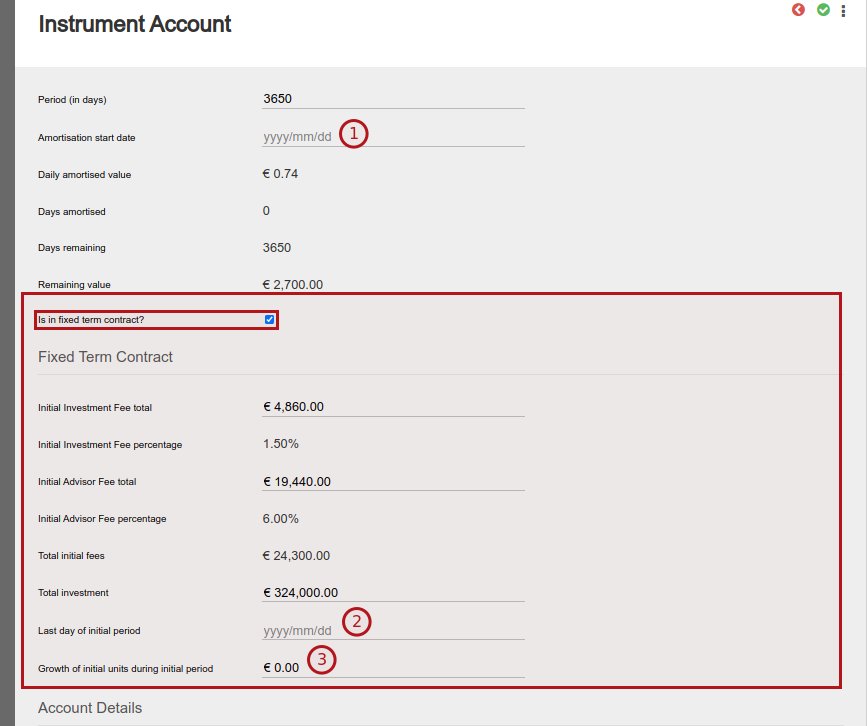
- Amortisation start date – This field determines when the depreciation of the early surrender fee instrument account starts. This field is initialised to:
a. If not a fixed term contract, this is the date of the first transaction on the early surrender fee instrument account
b. If a fixed term contract, this is the day the early surrender fee instrument account balance = “Total initial fees” (the date of the last transaction on the early surrender fee instrument account) - Last day of initial period – On or before this date, we calculate initial units. After this date, we use the value on the account inflated by the early surrender fee account value. This date will default to the day before the transaction date of the last investment that pays into the early surrender instrument account to complete the initial fees taken upfront.
- Growth of initial units during initial period – This amount is added to the value of the early surrender fee account after the initial period. This value is depreciated with the balance on the account. This value is initialized a day before the early surrender fee instrument account balance = “Total initial fees” (the date of the last transaction on the early surrender fee instrument account).
In the rare case where a multiple of the premiums make up exactly the “Total initial fees”, the user have to edit fields 1,2 and 3 to rectify the value on the account, as there will not yet be units available on the account when the initial period comes to an end. Remove the values in the three fields and update the fields manually when the next investment is made.
In such an instance the ‘Growth of initial units during initial period’ can be determined by drawing a statement on the account, with ‘To date’ set to the date of ‘Last day of initial period’. The Gain/Loss in the ‘Investment summary since inception’ section will provide the relevant value to use.
Also see growth on initial units for the calculation of growth.
Last Updated on 5 years ago by Antoinette Van Meyeren